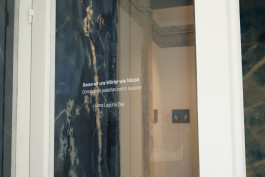
Bauen wir uns Wörter wie Nüsse. Construimos palabras como nueces, Lena Laguna Diel
25/04 - 13/06/2026
This exhibition unfolds through a striking intimacy. It speaks of loving and being loved, of looking at oneself, of recognising oneself in images, and of the need to construct a place of one’s own when belonging is never fully stable.
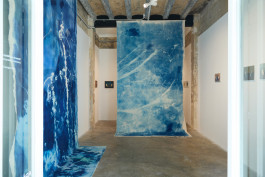
Lena Laguna Diel departs from a poem by her grandfather, Bertold Diel, written from a questioning of homeland, language, and territory. During the war, he fled Germany several times and hid in the forest to avoid being found. This image –the forest as refuge, as camouflage, as a space of survival– runs throughout the exhibition. The show is conceived, in fact, as a small forest. Upon entering, two large cyanotypes, De quien sembramos las semillas (2025), flank the space and lead the viewer through a narrow passage, as if the exhibition could not be grasped all at once, but only crossed.
These cyanotypes, made with plants gathered from the surrounding territory, hold a presence that is at once monumental and fragile. They are dried plants, endangered, carried by the river, without roots. Their blue tones evoke something both mystical and grounded, as if Lena sought to foreground what disappears, what remains in the background, what nature carries away yet still leaves as a trace.
Around them, a series of small-format paintings appears: two figures speaking, looking at one another, seemingly connected by threads or enclosed within bubbles. Yet these figures may also be Lena herself, addressing her own image. What initially emerged as conversations between colours has become a way of looking at oneself from the outside. “We must look at ourselves from the outside to know who we are,” she notes. These works suggest not only a search for identity but also a process of subjectivation: Lena locates herself in what she paints in recurring faces, in concealed figures, in the invisible energies that traverse bodies.
The watercolours from 2023, linked to the project Una fuerza loca , mark an early moment in which the human figure enters her practice. These are imagined figures or drawn from references to Old Master or Renaissance painting. What matters is not who they are, but what moves through them. Repetition here does not construct portraiture; rather, it transforms classical beauty into a kind of mask–an idealised presence that, through reiteration, becomes anonymous. In some works, pointillism operates as a vibrating force surrounding the figures.
The wax works, produced largely during a period of post-pandemic seclusion in Karlsruhe, reveal another central aspect of her practice: an ongoing experimentation with colour. Lena fragments, overlays, and delimits colour, establishing horizons–points where things begin and end. Within these small-scale works emerge nocturnal forests, scenes of flight, animals, fences, domestic fragments, and abstractions. Rather than forming a closed series, they function as a process of learning, a way of working through making. The material remains alive; colour becomes both a site of tension and a means of ordering.
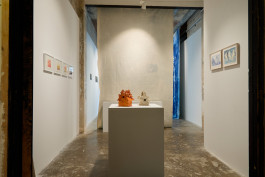
In the second, more contained space, the most recent drawings (2026) are presented. These are portraits of imagined, intuited, idealised figures presences that Lena needs to draw in order to approach them, to give form to doubt, and to explore desire, vulnerability, and love. In the series En mi corazón crece un ojo, the moment one becomes aware of what one feels –according to Lena– gives rise to a form of consciousness that emerges from the heart. It is a delicate image, allowing one to see from the place where one suffers, but also from where one loves.
At the centre, two ceramic houses, S’Aranella and S’Aranella II, refer to an isolated island near Cadaqués, inhabited by nature and almost inaccessible to humans. They appear as shelters, yet also as mirages.
Ultimately, the exhibition unfolds as an intimate forest –a space where family memory, uprootedness, love, and painting converge. Like rootless plants, like figures enclosed in bubbles, like bodies connected by threads, the works speak of an identity in search of a place, one that is never fully attained.
Lena Laguna Diel does not offer a closed answer to what it means to belong, to love, or to remember. Rather, she constructs a space from which these questions can be approached with fragility, with colour, with awareness, and with a profoundly resonant vulnerability.
– Anna Pérez Milán
Bauen wir uns Wörter wie Nüsse. Construimos palabras como nueces, Lena Laguna Diel
25/04 - 13/06/2026
This exhibition unfolds through a striking intimacy. It speaks of loving and being loved, of looking at oneself, of recognising oneself in images, and of the need to construct a place of one’s own when belonging is never fully stable.
Lena Laguna Diel departs from a poem by her grandfather, Bertold Diel, written from a questioning of homeland, language, and territory. During the war, he fled Germany several times and hid in the forest to avoid being found. This image –the forest as refuge, as camouflage, as a space of survival– runs throughout the exhibition. The show is conceived, in fact, as a small forest. Upon entering, two large cyanotypes, De quien sembramos las semillas (2025), flank the space and lead the viewer through a narrow passage, as if the exhibition could not be grasped all at once, but only crossed.
These cyanotypes, made with plants gathered from the surrounding territory, hold a presence that is at once monumental and fragile. They are dried plants, endangered, carried by the river, without roots. Their blue tones evoke something both mystical and grounded, as if Lena sought to foreground what disappears, what remains in the background, what nature carries away yet still leaves as a trace.
Around them, a series of small-format paintings appears: two figures speaking, looking at one another, seemingly connected by threads or enclosed within bubbles. Yet these figures may also be Lena herself, addressing her own image. What initially emerged as conversations between colours has become a way of looking at oneself from the outside. “We must look at ourselves from the outside to know who we are,” she notes. These works suggest not only a search for identity but also a process of subjectivation: Lena locates herself in what she paints in recurring faces, in concealed figures, in the invisible energies that traverse bodies.
The watercolours from 2023, linked to the project Una fuerza loca , mark an early moment in which the human figure enters her practice. These are imagined figures or drawn from references to Old Master or Renaissance painting. What matters is not who they are, but what moves through them. Repetition here does not construct portraiture; rather, it transforms classical beauty into a kind of mask–an idealised presence that, through reiteration, becomes anonymous. In some works, pointillism operates as a vibrating force surrounding the figures.
The wax works, produced largely during a period of post-pandemic seclusion in Karlsruhe, reveal another central aspect of her practice: an ongoing experimentation with colour. Lena fragments, overlays, and delimits colour, establishing horizons–points where things begin and end. Within these small-scale works emerge nocturnal forests, scenes of flight, animals, fences, domestic fragments, and abstractions. Rather than forming a closed series, they function as a process of learning, a way of working through making. The material remains alive; colour becomes both a site of tension and a means of ordering.
In the second, more contained space, the most recent drawings (2026) are presented. These are portraits of imagined, intuited, idealised figures presences that Lena needs to draw in order to approach them, to give form to doubt, and to explore desire, vulnerability, and love. In the series En mi corazón crece un ojo, the moment one becomes aware of what one feels –according to Lena– gives rise to a form of consciousness that emerges from the heart. It is a delicate image, allowing one to see from the place where one suffers, but also from where one loves.
At the centre, two ceramic houses, S’Aranella and S’Aranella II, refer to an isolated island near Cadaqués, inhabited by nature and almost inaccessible to humans. They appear as shelters, yet also as mirages.
Ultimately, the exhibition unfolds as an intimate forest –a space where family memory, uprootedness, love, and painting converge. Like rootless plants, like figures enclosed in bubbles, like bodies connected by threads, the works speak of an identity in search of a place, one that is never fully attained.
Lena Laguna Diel does not offer a closed answer to what it means to belong, to love, or to remember. Rather, she constructs a space from which these questions can be approached with fragility, with colour, with awareness, and with a profoundly resonant vulnerability.
– Anna Pérez Milán
Tuesday to Friday.
12-15 h (by appointment)
15:00–19:00h
Saturday. 11:00–14:00h
Tuesday to Friday. 15:00–19:00h
Saturday. 11:00–14:00h